Types / 1918
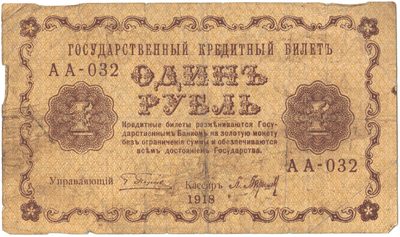
1 Rouble, RSFSR, series 1918
Государственный кредитный билетъ — Одинъ рубль
What was happening
The one-rouble note is the smallest denomination of the 1918 series and, by 1919, already close to meaningless as money.
These notes are a political fossil. They were designed under the Provisional Government in 1917, intended for release in 1918 — hence the date on their face — and then overtaken by the October Revolution. The Bolsheviks inherited the finished plates and, needing money far more than they needed new artwork, simply used them. The notes finally entered circulation in May 1919, dated 1918, issued by a state that had not existed when they were drawn.
The compromise is visible in the eagle. It is double-headed, as it had been for four centuries, but the crowns, the orb and the sceptre are gone — stripped by the Provisional Government to make a Russia that was neither imperial nor yet anything else. The Soviet government left it exactly as it found it. For several years the currency of the world's first socialist state carried the coat of arms of the Romanovs with the regalia filed off.
They are known as Pyatakovki, after Georgy Leonidovich Pyatakov, whose signature as Manager appears on every one. He ran the People's Bank of the RSFSR, sided with the Left Opposition, was expelled and readmitted to the Party more than once, and was convicted and shot in 1937 during the second Moscow show trial. His signature outlasted him by decades on paper that had itself been worthless since 1922.
The gold clause is still printed on the face — the State Bank exchanges these for gold coin without limit of sum. By 1919 that was not merely void but absurd: hyperinflation was already running, and within three years the whole issue would be swept away by the currency reform of 1922–24.