Types / 1899
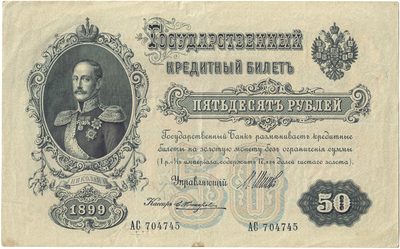
50 Roubles, Russian Empire, series 1899
Государственный кредитный билетъ — Пятьдесятъ рублей
What was happening
This note is a promise the Russian state had already broken by the time this particular copy was printed.
The gold clause across its face is the signature achievement of Sergei Witte's 1897 monetary reform, which put the rouble on the gold standard and made it freely convertible. That convertibility underwrote the enormous French and Belgian lending that financed Russian industrialisation through the 1890s and 1900s. The 1899 series was designed to advertise it: heavy intaglio engraving, multi-colour guilloche, and the promise printed out in full sentences rather than legal shorthand.
Convertibility was suspended on 27 July 1914, days into the war. The clause stayed on the plates. Every note of this series printed afterwards carried a redemption promise that no longer held, while the State Bank financed the war by printing. The money supply expanded several-fold; by 1917 the rouble had lost the greater part of its purchasing power, and the collapse ran on into the Civil War.
Ivan Pavlovich Shipov (1865–1919), whose signature appears on the later printings, was the last Governor of the State Bank of the Russian Empire, in office from 1914. He had earlier served as Minister of Finance and as Minister of Trade and Industry. After the October Revolution he refused to recognise the Council of People's Commissars or to release the Bank's funds to it, and organised the staff's resistance until he was dismissed. He joined the White movement in the south and died of typhus in 1919. His signature therefore marks the final imperial issues almost exactly.
One detail is easy to miss: the portrait is Nicholas I, not the reigning Nicholas II. The empire put its most autocratic nineteenth-century tsar — dead forty-four years when the series was designed — on one of its largest common denominations. And there is an afterlife. Through the Civil War these "Romanov" notes were often trusted more than the paper issued by either the Provisional Government or the Bolsheviks, and traded at a premium against both. People held the currency of a state that no longer existed because it was the last one that had ever promised gold.